Baby Cat Sleep Line Art: A Calm, Craft-Ready Embroidery Asset
First Impressions: Softness, Simplicity, and Instant Mood Shift
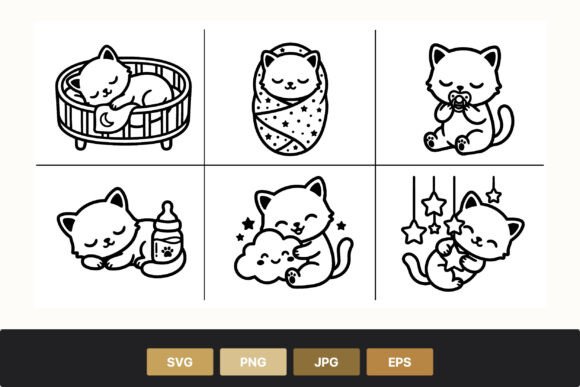
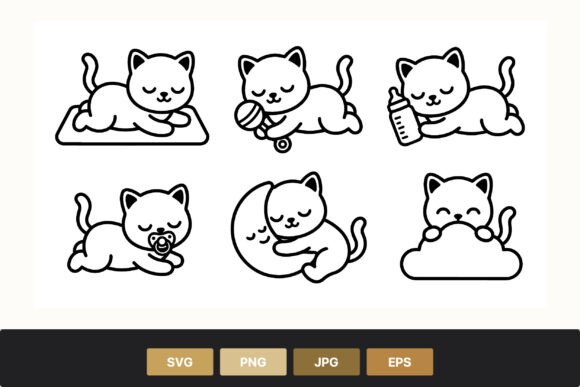
When I opened Baby Cat Sleep Line Art, I didn’t just see six sleeping kittens—I felt the hush of a nursery at dusk. The black-and-white line art carries quiet intention: closed eyes, gentle curves, tiny paws curled around a rattle or cradling a crescent moon. No shading, no gradients—just clean, confident strokes. That’s not minimalism for minimalism’s sake; it’s clarity built for stitch. As an embroidery designer who’s stitched everything from dense florals to intricate monograms, I immediately recognized this as a *breathing* design—one that leaves room for fabric texture, thread sheen, and human imperfection.
A Real Project Test: Embroidering a Linen Baby Pillow Cover
Last week, I used Baby Cat Sleep Line Art on a 12" x 12" linen pillow cover for a boutique baby gift set. I chose a soft black 40-weight rayon thread on natural unbleached linen, stabilized with medium-weight tear-away. The result? Crisp, legible lines—even the smallest pacifier outline held its shape. Each cat reads individually, yet the grouping feels cohesive, not crowded. Customers don’t buy “line art”; they buy *vibe*. And this delivers: peaceful, tender, unhurried. It’s the kind of detail that makes new parents pause mid-unboxing—not because it’s flashy, but because it feels *seen*.
Where This Design Truly Shines (and Where It Asks for Thought)
Baby Cat Sleep Line Art excels in low-density, high-intent applications. Think:
- Embroidered patches for baby onesies or organic cotton swaddles
- Subtle chest embroidery on neutral-toned sweatshirts or joggers
- Tote bag designs where the line work contrasts beautifully against canvas or denim
- Nursery tea towels or linen napkins—where simplicity reads as luxury
- Personalized holiday gifts (think: embroidered initials + one sleeping cat beside a cloud)
It’s also ideal for Etsy sellers offering digital embroidery files: clean lines translate reliably across mockups, and the theme has evergreen appeal for baby showers, gender-neutral gifting, and boutique branding.
Use With Care: Fabric, Fit, and Functionality
This isn’t a design that forgives every surface. On stretchy knits (like baby bodysuit fabric), I recommend testing with light cut-away stabilizer—those fine lines can blur if the ground fabric shifts mid-stitch. On dark fabrics, double-check thread contrast: a matte black thread on charcoal fleece may read as “soft gray” unless you opt for high-sheen polyester or add a white underlay. Curved surfaces—like the front of a structured cap—require careful digitizing adjustments; the current line art layout assumes a flat, stable hoop area. And while the crescent moon and cloud are charming, their thin connecting stems need verification at small scales—if you’re stitching a 2" version on a baby hat, zoom in on those junctions before finalizing your file.
Why Stitch Clarity Matters More Than You Think
Embroidery isn’t just about what looks good on screen—it’s about how it holds up after 30 washes, how it feels against baby skin, and whether it reads as handmade (not machine-made). Baby Cat Sleep Line Art avoids over-detail: no tiny whiskers to vanish in fill stitch, no nested loops that trap lint or fray. That means fewer thread breaks, cleaner trims, and a finished product that looks intentional—not rushed. For craft businesses, that translates directly to fewer returns, more repeat buyers, and Instagram-friendly unboxings.
Design Judgment for Real Business Use
If you’re an Etsy seller listing this as a digital embroidery file, remember: your buyers aren’t just downloading art—they’re investing time, thread, and reputation. So ask yourself before uploading:
- Does the line weight hold at 3", 4", and 6" sizes? (Test all three.)
- Are corners and curves smooth enough for satin stitch edges—or will they need slight rounding for fluid motion?
- Does the spacing between cats allow for consistent stitch density without overcrowding?
- Will this design feel cohesive alongside your other listings? (e.g., does it match your brand’s calm, modern, or whimsical voice?)
For apparel decorators: pair Baby Cat Sleep Line Art with tonal thread on heather gray sweatshirts—it reads as elevated, not juvenile. For handmade shop owners: print a simple black-and-white mockup on kraft paper tags or thank-you cards to reinforce the gentle aesthetic across your entire customer touchpoint.
Practical Designer Notes You’ll Actually Use
Before stitching your first Baby Cat Sleep Line Art project:
- Always test on scrap fabric—especially if using textured weaves like waffle-knit towels or slubbed linen.
- Review stitch density: line art like this should run between 8–12 stitches per mm for crispness without stiffness.
- Confirm hoop size compatibility: the layout fits comfortably in a 4" x 4" hoop, but verify spacing if scaling beyond 5".
- Inspect small details in your embroidery software—especially the bottle handle and cloud outline—to ensure no unintentional gaps or overlaps.
- Test black-and-white mockups on both light and dark backgrounds to gauge visual weight and contrast.
- Choose stabilizer intentionally: tear-away for stable wovens, cut-away for knits, and water-soluble for delicate silks or lace overlays.
- Verify licensing before selling finished items or bundling this as part of a commercial embroidery collection.
Final Thought: Not Just Cute—Cohesively Crafted
Baby Cat Sleep Line Art isn’t “cute filler.” It’s a thoughtful, restrained illustration that understands the language of thread and fabric. It works because it doesn’t try to do too much—and that restraint is exactly what makes it versatile, trustworthy, and quietly memorable. Whether you’re embroidering a single custom pillow for a friend or building a full nursery-themed digital product suite, this design earns its place—not as background noise, but as a calm, confident voice in your creative toolkit.