Cozy Window Cat Illustration
A Quiet Moment That Stitches Well
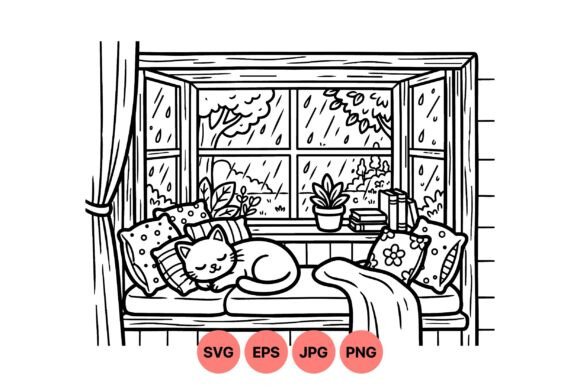
First glance at the Cozy Window Cat Illustration lands like a soft sigh — a black and white line art scene of a curled-up cat on a window seat, patterned pillows tucked in, a potted plant just visible outside, rain gently blurring the glass. It’s not busy. It’s not fussy. It’s calm, intentional, and deeply human in its quietude. As someone who’s stitched hundreds of designs onto everything from baby onesies to boutique aprons, I immediately saw how this illustration would translate: not as a flashy statement, but as a gentle signature — the kind customers pause over, smile at, and remember.
Where This Design Finds Its True Home
I recently tested the Cozy Window Cat Illustration as a centered chest embroidery on an unbleached organic cotton tote bag for a local indie bookstore’s “Rainy Day Reading” gift set. The result? Instant warmth. The clean linework held up beautifully at 3.8" wide — no bleeding, no lost detail — and the negative space around the window frame gave the stitching room to breathe. It worked equally well scaled down to 2.2" on a linen tea towel and up to 4.5" on a heavyweight sweatshirt back panel.
This isn’t a design that fights for attention. It invites it. That makes it ideal for:
- Personalized baby blankets and nursery pillow covers (especially in soft pastel thread on ivory fabric)
- Small-batch embroidered patches for craft fair vendors or Etsy sellers
- Subtle chest embroidery on relaxed-fit sweatshirts and oversized tees
- Custom aprons for bookshops, bakeries, or independent coffee roasters
- Digital embroidery file bundles marketed as “cozy lifestyle” design assets
It leans into handmade authenticity without demanding perfection — a real advantage when you’re stitching 30+ units for a small shop launch.
What to Watch For — Real Embroidery Nuances
The Cozy Window Cat Illustration is line art, yes — but not all lines are created equal in stitch. The window frame’s thin verticals and the delicate curve of the cat’s ear require attention. On stretchy fabrics like jersey or lightweight knits, those fine lines can distort if stabilizer isn’t layered thoughtfully. I recommend a medium-weight cutaway + light tear-away combo for anything with give.
Dark fabrics? No problem — but test your thread contrast first. A matte charcoal gray thread reads softer and more cohesive than bright white on navy or charcoal heather. And on textured surfaces like terry cloth towels or bouclé blankets, keep the scale above 3" to preserve legibility. Tiny details — like the subtle leaf veins on the potted plant — soften on nubby surfaces. They’re charming, not critical.
Curved surfaces (caps, curved pillow edges) demand careful hooping. The composition’s horizontal balance means it stitches cleanly across a flat front panel — but avoid wrapping it fully around a baseball cap’s crown unless you’re willing to split and reposition.
How It Shapes Perception — Beyond the Stitch
Customers don’t just buy a cat on a windowsill. They buy the feeling: stillness, safety, quiet joy. That emotional resonance lifts perceived value — especially for personalized gifts and boutique merchandise. When I added the Cozy Window Cat Illustration to a set of hand-stitched kitchen towels sold through my own small shop, buyers consistently mentioned “it feels like a hug” in reviews. That kind of language builds trust and repeat business.
For Etsy sellers and digital product creators, this illustration works hard as both a finished embroidery project and a printable mockup asset. Its high-contrast, scalable linework renders cleanly in grayscale previews — no color dependency, no licensing ambiguity in visual presentation. It supports brand consistency across physical products and digital listings without needing redesign.
Practical Designer Notes — Before You Hoop It Up
Before committing to production, do these five things:
- Test on scrap fabric — same weight, same weave, same dye lot as your final material. Watch how the lines settle after washing and drying.
- Review stitch density — even simple line art can pack tight runs if converted poorly. Look for smooth satin stitch transitions on curves (like the cat’s tail curl) and consistent running stitch spacing.
- Confirm hoop size compatibility — this design fits comfortably in a 4x4 hoop at standard scale, but double-check your file’s actual dimensions before digitizing or resizing.
- Inspect corners and intersections — does the window frame meet the sill cleanly? Do pillow folds intersect without overlapping stitches? Small inconsistencies become visible at scale.
- Verify licensing — since the download includes a Z (likely a ZIP), confirm whether the included files permit commercial embroidery use, resale of finished products, or bundling in digital shops. When in doubt, contact the creator directly.
Final Thought: A Design That Earns Its Place
The Cozy Window Cat Illustration doesn’t shout. It settles in. It’s the kind of embroidery file you reach for when you want your product to feel considered, not crowded — when your customer values mood over motif. It’s equally at home on a baby’s burp cloth and a ceramicist’s limited-edition apron line. That versatility, grounded in thoughtful line quality and balanced composition, is rare. For illustrators, crafters, and creative entrepreneurs building a recognizable, emotionally resonant catalog — this isn’t just another graphic. It’s a quiet anchor. And in a noisy handmade market, that kind of calm clarity is worth every stitch.