Window Cat and Books Night Design
A Quiet Scene That Stitches With Intention
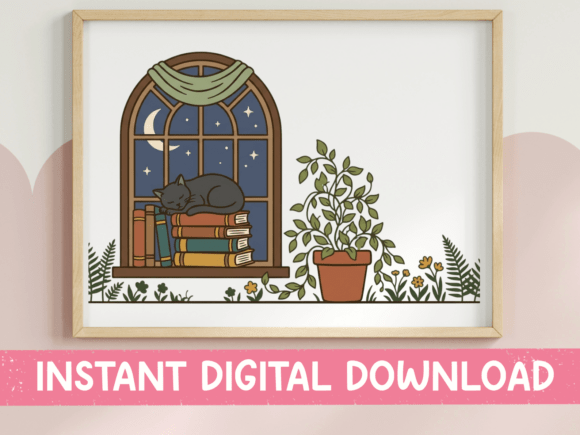
First glance at the Window Cat and Books Night Design lands softly—like a cat settling onto a sun-warmed bookshelf. It’s not loud or flashy. It’s a line-art world built for stillness: an arched window, sage green curtain draped just so, deep blue starry sky beyond. No clutter. No forced whimsy. Just quiet companionship—cat, books, night—and that subtle, grounded warmth that makes people pause mid-scroll on Etsy.
I tested it last week on a heavyweight organic cotton tote bag for a local indie bookstore’s holiday collection. Not as a digital preview—but stitched, trimmed, pressed, and held in hand. That’s where this design reveals its real personality: it breathes well in thread. The lines are clean enough for crisp running stitch definition, but generous enough to avoid fragility on textured fabric. It doesn’t fight the machine; it invites careful stitching.
Where This Design Finds Its Best Footing
The Window Cat and Books Night Design thrives in projects where mood matters more than motion. Think:
- Sweatshirt embroidery—centered on the chest or back, especially in heather grey or navy. The arch echoes the curve of the neckline; the stars read clearly even at 3.5" wide.
- Embroidered patch—heat-sealed or sewn onto denim jackets, canvas aprons, or baby bibs. Its self-contained shape means no awkward cutouts or floating elements.
- Pillow cover or tea towel—where softness and narrative matter. Customers don’t buy “a cat.” They buy “the feeling of reading with my cat while rain taps the window.” This design delivers that quietly.
- Personalized gift—for teachers, librarians, writers, or new parents who value calm over chaos. Paired with a handwritten note, it reads like care—not commerce.
It also works well as a digital embroidery file for craft businesses building cohesive seasonal collections. I’ve seen it paired with minimalist moon-phase designs or typographic quotes about reading—no visual competition, just thoughtful layering.
Where to Proceed With Care
This isn’t a one-size-fits-all machine embroidery design. Its charm lives in restraint—and that means limits you’ll want to honor:
- Small hoop sizes (<4") demand attention. The arch and curtain drape need breathing room. Below 3", fine details blur; stars lose distinction. Test at your target size before batching.
- Stretchy fabric (like lightweight knits or ribbed baby onesies) requires firm cutaway stabilizer—and possibly slight digitizing tweaks to reduce pull. The line weight assumes stability.
- Dark fabric backgrounds call for high-contrast thread: charcoal grey or deep forest green instead of black, which can flatten the depth. Always check a black-and-white mockup first.
- Curved surfaces (caps, curved tote handles) test the arch’s symmetry. On a low-profile cap front, consider simplifying the curtain drape to avoid distortion.
- Frequent-wash items (baby clothes, kitchen towels) benefit from slightly increased stitch density in the arch outline—just enough to lock edges without stiffening the fabric.
What It Adds—Beyond Thread and Fabric
Using the Window Cat and Books Night Design does more than fill space. It signals intentionality. When customers see this on a handmade product, they register: *This wasn’t rushed. This was chosen.* That builds trust—especially for Etsy sellers and small shop owners whose buyers prioritize authenticity over polish.
For boutique branding, it supports a cohesive aesthetic without shouting. It pairs naturally with earthy packaging, linen tags, and muted photography. No need to over-explain. The design carries its own quiet story.
And for personalized gifts? It elevates perceived value. A plain sweatshirt becomes a meaningful object—not because it’s expensive, but because it feels *known*. That’s gold for creative entrepreneurs selling emotional resonance, not just apparel.
Practical Notes From My Hoop
Before cutting into your good fabric—or listing it as a commercial embroidery asset—do these five things:
- Test on scrap fabric matching your final substrate (e.g., terry cloth for towels, fleece for blankets). Watch how the curtain drape settles.
- Check thread color contrast across light and dark backgrounds—not just on screen. Sage green thread on navy reads differently than on cream.
- Review stitch density in the star field. Too sparse = invisible. Too dense = stiff. Aim for gentle rhythm, not uniformity.
- Confirm licensing if selling finished products or bundling the digital embroidery file with other design assets. Not all T-Shirt Designs allow commercial use out of the box.
- Use proper stabilizer—especially for thin or textured fabrics. A single layer of tear-away won’t hold the arch cleanly on slubbed linen.
This isn’t a “plug-and-stitch” graphics file. It’s a quiet collaborator. Respect its pacing, honor its simplicity, and it will reward you with handmade presence—not just another embroidered item.